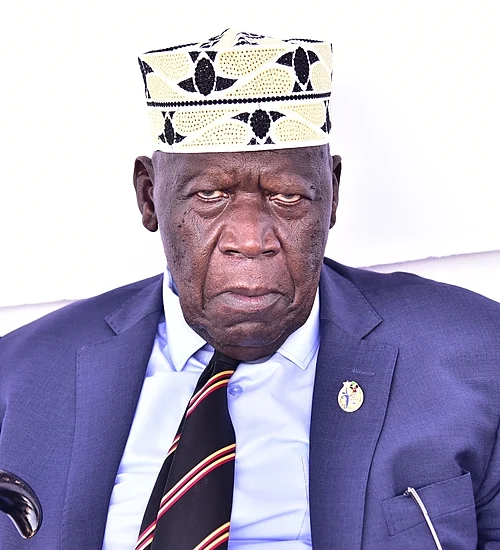
National- Gen.Moses Ali (5 April 1939 – 18 July 2026) was a Ugandan lawyer, military officer, and politician who served as 2rd prime minister of Uganda from 2021 until his death in 2026.
Ali served in the cabinet of Uganda as the 3rd prime minister and Deputy Leader of Government Business in Parliament from May 2011 until June 2016.
He also served as the first Deputy Prime Minister from June 2016 to May 2021. He served as an elected MP for East Moyo County in Adjumani District from 2011 until his death.

He was born to Muhammad Ali and Veronica Porsche Ali from Adjumani District. He sat his PLE at Erepi Church of Uganda in 1957, and earned a certificate at Church of Uganda Junior S. S. in 1957. From 1964 to 1966, he went to Old Kampala S.S. for his general certificate in education. He earned a certificate in Officer Cadet Training in Israel.
He also undertook a certificate in paratrooper Instructors Training in Israel in 1969, attained a certificate in Company Commanders Course in Israel in 1972. In 2007, he got a certificate in education in Law at the University of Wolverhampton.
He hold a Bachelor degree of Law from Makerere University and a diploma in Legal practice from Uganda law development center in Kampala.
He also held qualifications from various military educational institutions in Uganda, Israel, and the United Kingdom.
Ali was the appointed officer in charge of training and commissioned to the rank of 2nd Lieutenant in the Uganda Paratrooper School in 1969.
Ali was involved in the 1971 Ugandan Coup d’etat that overthrew President Milton Obote and brought Idi Amin to power. He consequently rose in the ranks during the 2rd Republic of Uganda when Amin ruled the country.
Ali was appointed Minister of finance . This appointment forced Journalists to describe him as one of Amin’s “closest henchmen”.
As Minister of Finance, he used his position to organize an Islamic charity. This garnered him a lot of popular support, but also raised Amin’s suspicions as he feared Ali was attempting to construct a Muslim political base of support. Indeed, Ali gained many followers within the Uganda army.
In April 1978, President Amin organized a meeting in Kampala where he railed against ministers whom he deemed disloyal, too powerful or incompetent, including Ali whom he accused of mismanaging the bank of Uganda, gross corruption and Mishandling of Muslim Supreme council funds among others.
Amin became so angry during his speech that he threw a trash can at Ali.
Having realized that his situation was untenable, Ali got away as soon as possible. He quietly sneaked out of Kampala in his private car and fled to his home in the west Nile Region.
When he got there, however, a group of hit men attacked him, but he fended them off in a gunfight. Ali was convinced that his downfall and the attempted assassination had been organized by the Uganda Army commander Yusuf Gowon , a long-time rival of his. Amin subsequently stripped him of all of his military honors. However, Amin was still wary of Ali’s large following, and only formally fired him from his ministerial portfolio in August 1978. Around October, ten SRB agents attempted to arrest Ali, but were killed.
When Amin’s regime collapsed during the Uganda – Tanzania war the of 1978–1979, Ali fled into exile in southern Sudan (now in the nation of south Sudan , finding refuge in Nimule .In the 1980s, he led the Uganda National Rescue Front in an armed rebellion against the government of reinstated President Obote and became a warlord ruling a fief in southern Sudan. Among the insurgents of the early Ugandan Bush war , he waged the “most effective guerrilla campaign”.
Using his influence and military powers to his advantage, Ali eventually negotiated a favourable deal with Yoweri Museveni who took power as President at the Bush War’s end in 1986. His forces were integrated into Uganda’s new national army, the National Resistance Army which later became the Uganda people ‘s Defence Force , and he was appointed a Major General. As a result of his powerful position in Uganda’s new government and military, Ali became highly influential and quite wealthy.
He was appointed the third deputy prime minister and tourism, wildlife, and antiquities minister on 17 July 1995. In 1996, he was the representative for East Moyo- Adjumani District and appointed the ministry’s 2nd deputy prime minister and minister of trade and industry. In 2000, he was the minister of Internal affairs.
Ali even rose to 1st deputy prime minister in Museveni’s government. He served in the Ugandan Parliament of Uganda from 2001 until his death in 2026. He was further promoted to Lieutenant General on 13 March 2003, but lost both his parliamentary seat and his ministerial appointment in 2006. In 2011, at the age of 72, he regained his position in parliament and was assigned new cabinet responsibilities. In the next year, Ali was once again promoted to the rank of general in the Uganda People’s Defence Force.
In 2016, following his re-election to parliament, he was again appointed First Deputy Prime Minister and Deputy Leader of Government Business in Parliament.
After the 2021 Ugandan general elections, Museveni reorganized his cabinet, with Ali being appointed Second Deputy Prime Minister and the parliament’s Deputy Leader of Government Business.
In the 2026 general elections he was elected in the Adjumani West constituency and sworn in on 13 May 2026.
He was appointed to the parliament’s Committee on ICT and National Guidance and the Committee on Subsidiary Legislation. On 26 May 2026, Ali was replaced as second deputy prime minister by Crispus Kiyonga while his son Siraj Musa Ali was named as minister of works and transport by M
Moses Ali died on 18 July 2026 at Nakasero Hospital in Kampala where he had been admitted earlier in the week following a period of declining health.
President Yoweri Museveni officially confirmed the news in a public statement he posted on X (formerly Twitter), expressing deep sorrow and mourning him as a long-serving soldier and political leader. The former deputy prime minister was 87.